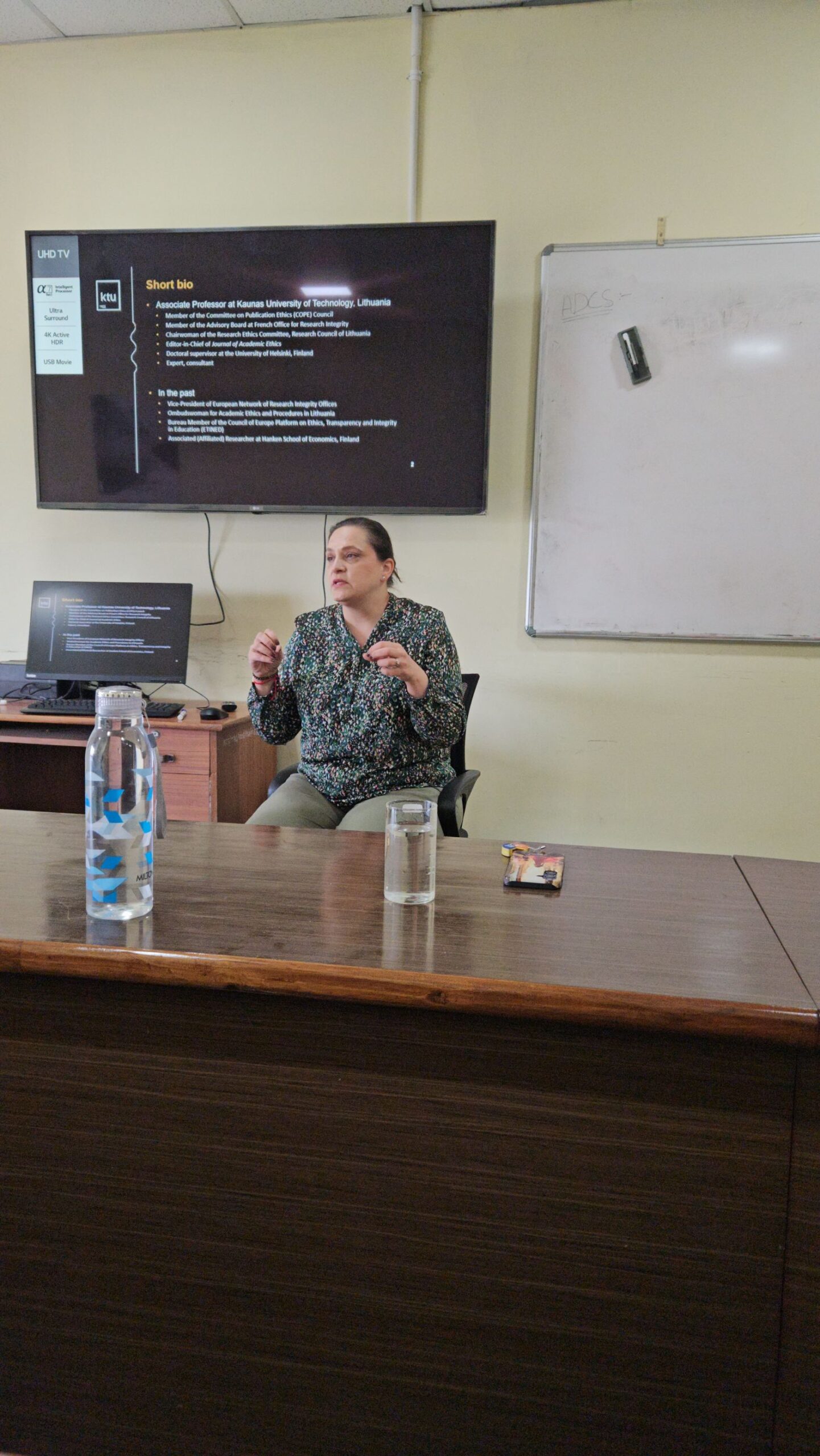
The KIIT School of Public Policy hosted Prof. Loreta Tauginienė from Kaunas University of Technology, Lithuania, for an engaging session on “Artificial Intelligence in Public Sector Research: Ethical Oversight, Risks, and Policy Design.” The session explored the rapidly expanding role of Artificial Intelligence in governance and public-sector research while drawing attention to the ethical and regulatory questions accompanying its adoption.
Prof. Tauginienė discussed how AI is increasingly influencing the ways in which public institutions conduct research, process information, support decision-making, and approach governance challenges. While these technologies offer significant opportunities to improve efficiency and analytical capabilities, their growing use also raises important concerns regarding accountability, transparency, fairness, and responsible oversight.
A central theme of the session was the need to understand AI not simply as a technological tool but as an emerging area of public policy and governance. The discussion encouraged students to examine the risks that may arise when automated systems influence public decisions and emphasized the importance of establishing appropriate ethical safeguards and institutional mechanisms.
Prof. Tauginienė highlighted that policymakers must engage with AI as more than users of new technology. They also have a responsibility to act as ethical architects, developing frameworks that determine how AI should be designed, deployed, monitored, and held accountable within public institutions. This requires policymakers to balance technological innovation with public values and institutional responsibility.
The session provided students with an opportunity to consider the intersection of technology, ethics, governance, and policy design. It reinforced the importance of developing responsible approaches to technological transformation and demonstrated how future policymakers will increasingly need to engage with the social and ethical implications of AI while designing governance frameworks that protect public interest and maintain institutional trust.